 Video on Patreon
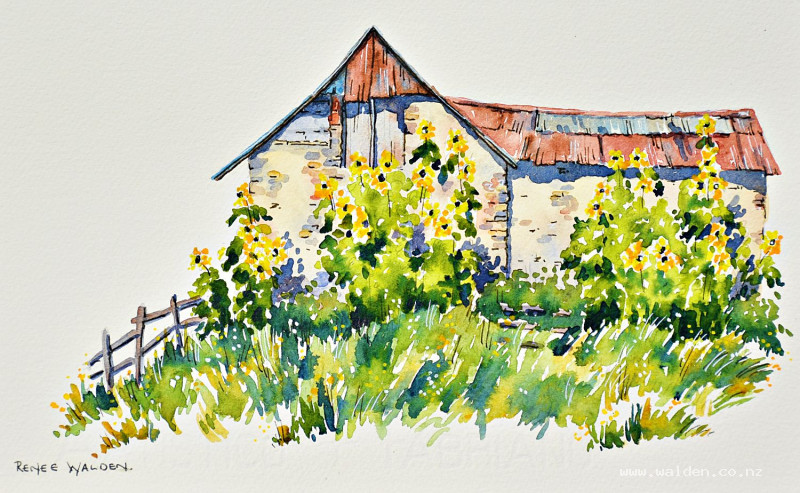
Giant sunflowers in front a barn
14 December 2022
Video - Level ◆◆◆
I've been going past this scene often in the last 3 months, watching those sunflowers grow and grow, until they've become these giants! The other day I couldn't resist and had to take a photo. I knew straight away it would make a fun painting lesson.
I've sketched this scene as I would have if I had been standing there with my sketchbook - so it's loose and free and super fun :-)
Happy painting!
Video run-through...
About This Painting
This is a scene that had been waiting to be painted for months — an old stone barn half-hidden behind a towering field of sunflowers, spotted on a roadside and impossible to drive past any longer. The approach is looser and more sketchy than a fully rendered scene, leaning into the spontaneous, sketchbook feel that suits the subject. The sunflowers are the whole point, so they're the starting point for everything — the building, the meadow, and all the other elements are arranged around them.
Two reference photos are provided: one zoomed in on the barn and sunflowers, and one showing the full scene with mountains and sky. How much of the wider scene to include is entirely up to you.
The Pencil Drawing
Start with the sunflowers rather than the building. This is a deliberate choice — when the sunflowers are your story, you build the composition around them rather than fitting them in around a structure.
Draw the sunflowers facing in different directions, as they grow naturally — some facing directly forward, some turned left or right, one drooping slightly. Group them in clusters with some overlapping and some standing alone. Aim for an odd number overall. Give them long, prominent stalks so they read as genuinely giant, with the flower heads well above the roofline of the barn.
Once the sunflowers are placed, fit the building around them. The barn has a wonderfully wonky, curved roofline — don't try to straighten it, lean into it. The corrugated iron roof is higgledy-piggledy, the stonework is irregular, and that character is what makes it worth painting. Indicate a selection of stones around the edges of the building and near any openings, just enough to remind yourself later what's there. Note the direction of the wooden boards — vertical — and the corrugation lines on the roof.
Add leaves to the sunflower stalks, a simple gate, a wobbly fence line as a diagonal element, and a few daisies in the meadow foreground. Allow some sunflowers to overlap and escape from behind the building. Keep a few gaps in the composition intentionally open — they'll breathe better once the colour goes in.
Pencil can be left visible in the finished painting or lightened with a kneadable eraser — both are valid choices. Working with visible pencil is part of the sketchbook aesthetic.
Painting the Stonework
For the stones, mix a range of colours rather than using a single flat gray. A good starting palette: natural sienna (or raw sienna) for the warm sandy tones, a cool gray mixed from ultramarine and burnt umber, a warmer gray with the balance shifted toward the brown, and a reddish-brown — quinacridone sienna or burnt sienna — for variation. Mixing blue and brown for your grays rather than using Payne's gray straight from the tube means the colours will separate when worked wet, giving natural texture in the stone.
Block in the stone areas loosely, varying the colour as you go — some warm, some cool, some slightly reddish. Leave the concrete blocks a different tone to the natural stone. Work wet so the colours bleed into each other softly. Indicate a few individual stones by leaving fine gaps of lighter colour between them, particularly near the edges of the building and around the doorway.
Painting the Roof and Wooden Elements
The corrugated iron roof takes warm rusty tones — burnt sienna and natural sienna — applied loosely to suggest aged, weathered metal. Leave some lighter areas where the metal catches the light. The wooden boards above the door are painted in the vertical direction they run, with slight tonal variation between boards. A few gaps or darker marks between the boards suggest their separation without needing to be literal about it.
Painting the Sunflowers
The sunflowers are the stars, so give them time and attention. Each flower head has a dark brown-to-black centre — a rich mix of burnt umber and ultramarine, or indigo — with petals radiating outward. Paint the petals in a strong warm yellow, working in the direction they grow outward from the centre. Use a brighter yellow for the sunlit petals and let it shift slightly cooler toward the edges and on the shadowed side.
Yellows and warm reds can fade as they dry, so a second layer may be needed once everything is thoroughly dry. Quinacridone gold or a warm golden yellow alongside the brighter yellow adds depth and keeps the colour interesting. Work loosely and vary the petal shapes — not every petal needs to be perfect.
The stalks and leaves are painted in a range of greens, varying from warm to cool. Keep them loose and gestural.
The Meadow and Foreground
The meadow is painted with varied, directional brushstrokes suggesting grass and wildflowers. Mix greens from yellow and blue rather than using a tube green, and vary them across the foreground — some warm and yellow, some cooler. Drop in a few daisies with small marks of white or very pale yellow. Placed near the base of the sunflowers, these small flowers serve a compositional purpose: the size contrast makes the sunflowers read as genuinely enormous.
Leave some areas of lighter, textured colour in the meadow and don't fill everything in — the eye needs somewhere to rest.
Shadows
Once the painting is thoroughly dry, draw the shadow shapes lightly in pencil before picking up a brush. Working out the shadows at the drawing stage means you can paint them quickly and confidently without stopping mid-stroke to think.
The shadows on the barn are painted in one continuous pass where possible, working left to right. Use the same blue-gray mix as the stonework but thicker and more heavily weighted toward ultramarine. The shape of the shadow under the eave describes the wonkiness of the corrugated roof — let it be uneven. Add shadow inside the doorway, and cast shadows from the sunflowers onto the wall — these bring the flowers forward and anchor them convincingly to the building. Soft shadow marks on the fence add dimension there too.
Pure indigo can fill in the very darkest areas if the mix isn't reaching deep enough. Stand back and assess once the shadows are in, and add a second pass anywhere that still reads as too flat.
Pen Work
With everything dry, a fountain pen or fine-nib pen with dark brown ink is used to sharpen and define — not to outline everything, but to emphasise shadow areas and add character. Work tentatively at first; you can always add more but can't remove it.
Concentrate the pen work on the man-made elements: the barn walls, the corrugated roof (watching perspective on the corrugation lines), the gate and fence. Add shadow marks to a selection of individual stones, varying them so they don't form a pattern. For the sunflowers, darken the centres and add stalks. Keep a lighter touch in the meadow and foliage — just enough pen marks to tie the whole composition together without it looking like a colouring book.
Finish with a white gel pen for highlights on sunlit edges and small dots of light in the meadow. A yellow Posca marker can refresh any sunflower petals that need brightening. A few scattered white dots add a pleasing sparkle throughout.
Background
The background can be left as bare paper — which suits the sketchy, graphic quality of this approach — or a very soft wash of muted greenery can be added behind the building to ground it in its setting. A sky is also an option. The choice depends on how much context you want to give the scene, and there's no wrong answer.
Resources...
* Reference photo
* Reference photo
Join me on Patreon
Join my Adventures in Colour Tier for $16 to access this post and my full library of over 200 others including deep-dive videos and step-by-steps.