 Video on Patreon
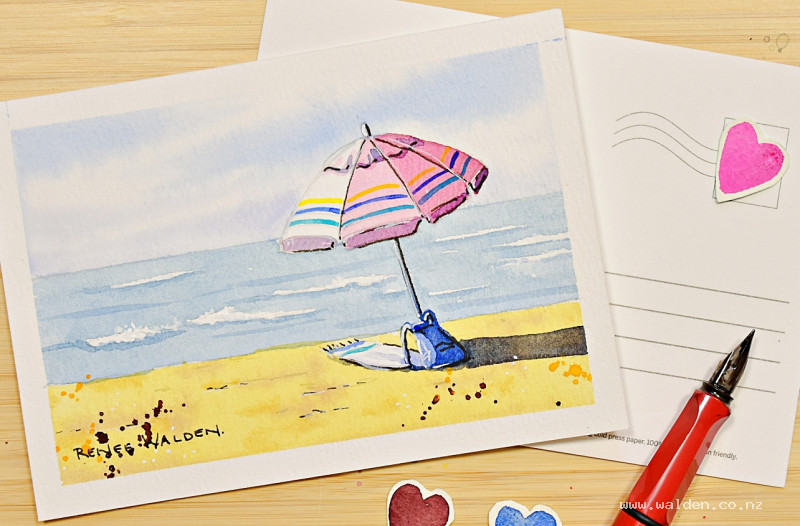
Beach umbrella
2 July 2026
Video - Level ◆◆◆
This week, we're heading to the beach to paint an umbrella. Mine's pink, of course, but you can make yours your favourite colour — I'll show you how.
It'd be lovely if you shared your postcards in our
Video run-through...
About This Painting
The first in a series of four summer postcards — a beach scene with a striped umbrella, towel, and backpack. It's designed to be quick and fun, with the umbrella as the clear focal point and everything else kept simple and supporting. The sky is a hazy seaside blue, the sea a gentle greenish-blue with white wave streaks, and the sand a warm golden tone. Choose your own colours for the umbrella — this is a good opportunity to paint with your favourites.
A traceable drawing is available in the lesson description.
The Pencil Drawing
Keep the horizon line straight — measure from the bottom of the page to check. Get the angles of the umbrella panels correct, and add a few loose wave lines in the sea to give it movement. Shadow hatching is optional; you can mark shadows with darker paint instead.
Colours to Prepare
- Cobalt blue — for the sky and sea base
- Lavender (or cobalt blue with a tiny touch of violet) — for the hazy horizon in the sky
- Natural sienna plus a touch of yellow — for the golden sand
- Greenish blue — cobalt blue with a small amount of green added, well diluted, for the sea
- Your chosen umbrella colour — any hue works; the example uses quinacridone rose
- Ultramarine and quinacridone sienna — mixed to a blue-gray for cast shadows
- White gouache — for wave tidying and splatter
Sky
Wet the sky area with a flat brush, which makes it easier to get a clean straight horizon and to work around the umbrella shape. Once the paper is evenly damp with no pooling or dry patches, drop in lavender along the horizon and two loose streaks of cobalt blue above it. Let the water carry the paint — don't scrub. The whole sky takes about a minute. Check for any white halo around the umbrella edge before leaving it to dry naturally, then finish with a hair dryer when nearly dry.
Sea
Once the sky is dry, run a strip of tape along the horizon line to keep it clean. Mix cobalt blue with a small amount of green — much less intense than the reference photo. Paint with loose horizontal strokes, leaving unpainted white paper for the wave crests: smaller gaps near the horizon, larger ones toward the foreground. Paint straight over the umbrella pole — it can be recovered later with a white gel pen. Remove the tape by warming it gently first.
Sand
Mix natural sienna with a touch of yellow and plenty of water — keep it pale, as it's always easier to darken later. Paint the whole beach area, shaping carefully around the towel and backpack. While still slightly wet, add some texture with burnt umber and thicker natural sienna in a few places to suggest footprints and surface variation.
Umbrella: Form First, Stripes Second
To give the umbrella a convincing rounded form, paint the shadows before the stripes. Divide the panels into zones from lightest to darkest — the panel catching the most light is left unpainted, the next is pale, then medium, then darkest. Paint one panel at a time and dry between each so the values stay distinct. If your chosen colour can't go dark enough for the deepest shadow panel, deepen it with a complementary colour or a touch of brown.
Once all the shadow panels are dry, add the stripes on top. Painting stripes over dry shadow keeps them sharp — if you did it the other way around, the shadows would soften the stripe edges. Use a fine brush or a fine-tipped marker if brush control is tricky.
Towel and Backpack
Keep these simple — they're supporting elements, not the focal point. For a white towel, use a very diluted version of the sea colour to suggest a few soft folds and shadows. Paint the backpack in a single flat wash and leave it at that, or add minimal detail if you'd like.
Wave Shadows
The wave crests can look cut out without some shadow beneath them. Mix the same sea colour and glaze a thin wash just below each wave crest to give it depth. Add a little of the same mix, very diluted, into the foamy white areas to suggest shadow within the froth. Tidy any wave shapes with white gouache if needed, but keep it restrained — the waves are background.
Cast Shadows
Mix ultramarine and quinacridone sienna for the cast shadows — mostly blue, with a little more brown where shadows fall on sand. Add shadows under the umbrella, beneath the towel and backpack, and anywhere an object sits on the ground. Darken the shadow side of the backpack slightly.
Final Details
A little pen work in brown ink on the shadow sides of objects sharpens edges and adds definition. A white gel pen recovers the umbrella pole and picks out any highlights. A small amount of splatter — yellow, a darker colour, and white — adds energy and movement. Test the toothbrush on scrap paper first.
Resources...
* Reference photo
* Drawing to trace
Join me on Patreon
Join my Adventures in Colour Tier for $16 to access this post and my full library of over 200 others including deep-dive videos and step-by-steps.