 Video on Patreon
Autumn colours in the Pyrenees
25 January 2023
Video - Level ◆◆◆
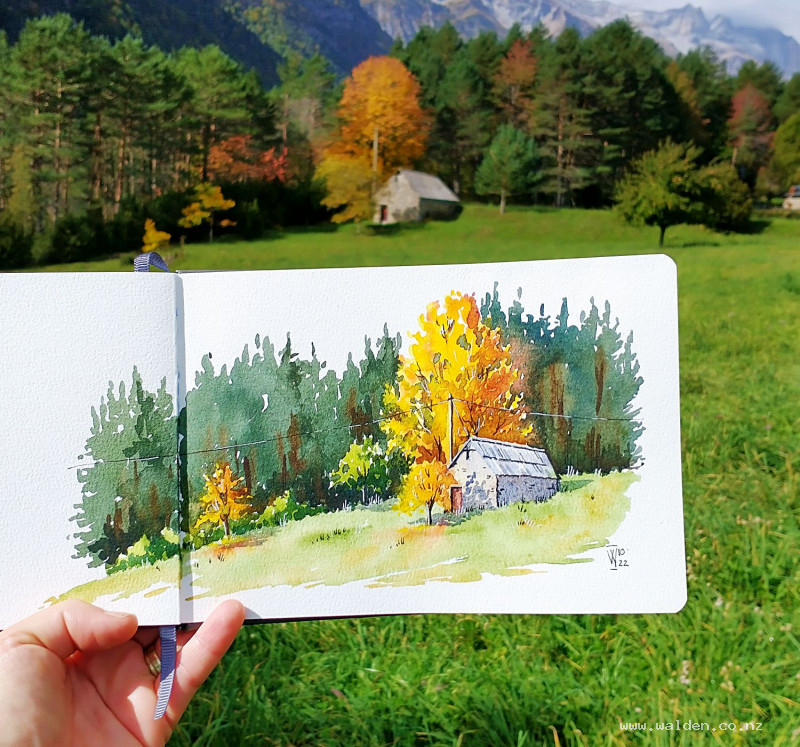
Join me sketching outside in the beautiful Pineta Valley. I spotted this huge autumn tree dwarfing a lovely little barn right outside the national park of Ordesa y Monte Perdido. I knew immediately I'd love to share it with you.
Video run-through...
About This Painting
This is a location sketch painted on a Saturday morning in the Pineta Valley in the Spanish Pyrenees, with the National Park of Ordesa and Monte Perdido as the backdrop. The night before had brought a fresh dusting of snow to the higher peaks. The scene that caught the eye — and became the focus of the painting — was a magnificent golden autumn tree dwarfing an old stone barn, set against a dark wall of conifers. The mountains, the meadow, the other trees: all secondary. The tree is the story.
Painted in a sketchbook spread, working from the right-hand page across to the left to follow the natural slope of the meadow.
Composition and What to Leave Out
When painting outside with a rich scene in front of you, the temptation is to include everything. Here, the mountains, multiple trees, the meadow, and the hills were all available — but the decision was to focus on the tree and the barn alone. The conifers behind are included, but only as a dark backdrop to make the golden tree pop.
The composition is arranged with the barn positioned relatively small, so the tree genuinely dwarfs it. A power pole is included because it's there — it's part of the reality of the place rather than a pristine idealised scene. If you'd prefer to leave it out, that's equally valid.
For a sketchbook spread, the right-hand page holds the main painting with space on the left for writing the story of the morning.
The Pencil Drawing
Start with the barn, placed modestly so there's plenty of room for the tree to dominate. Check the proportions — this barn has a large roof relative to its walls, and the walls are partially set into the slope. Work lightly at first to get the perspective right before committing darker lines.
Add the power pole and the main tree, making sure the tree is genuinely tall — well above the roofline. Then sketch in the supporting trees: a golden foreground tree, another golden tree for a group of three, and the mass of conifers behind. Give the conifers slightly irregular tops even if in reality they're evenly planted — it reads more naturally. Add the slope of the meadow and indicate a few fallen leaves beneath the golden trees.
Go over the drawing darker once you're happy with it. Painting outside with saturated colour can swallow a light pencil sketch, and the pencil marks showing through the washes add to the sketchy quality.
Painting the Barn
Start with the barn so the trees can be shaped around it later. For the roof, mix ultramarine blue and burnt umber with plenty of water — keep it on the blue side to distinguish it from the warmer stone walls. Paint in the direction of the corrugations and leave a few white gaps where the sun catches the metal.
While the roof dries, add the red door: dragon's blood, or burnt umber with a touch of red, dulled slightly so it doesn't look too new.
Don't paint the walls until the roof is thoroughly dry to avoid the two merging.
Painting the Meadow
Use a larger brush for the meadow. Mix sap green with a touch of natural sienna for the autumn grass colour and paint in the direction the ground slopes. Tease the paint into the base of the barn walls so the grasses appear to grow around the building rather than stopping abruptly at it. Drop in a thicker, slightly darker mix of sap green in places for variation, then while still wet, add Hansa yellow deep and a touch of pyrrole orange beneath the trees where fallen leaves have gathered.
The Barn Walls
Once the meadow is almost dry, add the stonework with the same ultramarine and burnt umber mix used for the roof, shifted slightly warmer with a little more burnt umber. Keep it light on the sunlit front wall — add a touch of natural sienna here. Go darker on the shadowed side. Tease the paint into the grass at the base so the barn sits naturally in the scene rather than floating above it.
Painting the Golden Trees
The golden trees are painted first as shapes of warm colour — the dark conifers behind them come later and will define their edges through negative painting.
Mix a warm yellow (Hansa yellow deep or cadmium yellow) and a cooler yellow (Hansa yellow medium or cadmium yellow light) — the difference between the two adds variety across the canopy. Dragon's blood or a reddish brown gives the deeper, rustier areas. Work wet on wet, dropping in the different yellows and letting them merge. Some areas lean orange, some almost green toward the edges where light filters through. Don't overwork it — the wet merging of colours is what gives autumn foliage its warmth and depth.
The foreground tree is painted similarly but with less detail — most of the attention should stay on the main tree.
The Conifers (Negative Painting)
This is the step that makes the golden trees glow. Rather than painting the trees themselves, you paint the dark forest behind them, and the tree shapes emerge through the contrast.
Mix indigo and sap green for a rich dark green, then add a little burnt umber to dull it slightly — with so much vibrant colour elsewhere in the painting, having one area that isn't shouting is a relief. Keep the tops of the conifers slightly lighter (more water in the mix) and darken progressively toward the bottom of the forest where the canopy is thick and little light reaches.
Use a brush with a good point to imply conifer tops at the skyline. Cut in carefully around the golden tree shapes with negative painting, giving the main tree a clean, well-defined silhouette. Work quickly — if the golden tree washes are still slightly damp, a little soft blending at the edges is fine, but be careful not to drag dark paint into the wet golden areas.
While the conifers are still slightly damp, add very dark trunks with a small brush and dark brown — just implied, not overly literal.
Shadows
Once the trees and barn are dry, add the shadow side of the barn in a cool blue-gray (more ultramarine than burnt umber — a cool shadow against the warm tree colours). Tease the bottom edge into the grass so it doesn't appear hard. Add the mottled shadow cast by the nearby tree onto the barn wall and across the meadow — in autumn the sun is lower and shadows are longer than in summer. This cast shadow is what connects the tree to the building and makes the whole scene feel of-a-piece.
Add deeper shadows at the base of the conifer forest — almost no light reaches there — using the same dark green mix thickened with very little water.
Pen Work
Three pens are useful here: a fountain pen with dark brown ink for the building and shadow sides, a white gel pen for sunlit edges and branches, and a yellow Posca marker for leaf accents.
Concentrate pen work on the barn: the corrugation overlaps on the roof, the shadow side of the walls, the door, and window openings. Add shadow sides to the tree trunks and a few branches. Include the power pole and its wire to the building if it's in your scene — a few confident strokes. Pen marks in the foliage and grasses stop everything from looking too concentrated in one place.
The white gel pen picks up sunlit branches, the light catching the corrugated roof, and highlights on the tree trunks. The yellow Posca can add individual leaf accents in the canopy and suggest fallen leaves on the ground — useful at the end of a long session when a pen feels more controllable than a tiny brush.
Initial and date. Write the story of the morning on the facing page if working in a spread.
Resources...
* Reference photo
Join me on Patreon
Join my Adventures in Colour Tier for $16 to access this post and my full library of over 200 others including deep-dive videos and step-by-steps.