 Video on Patreon
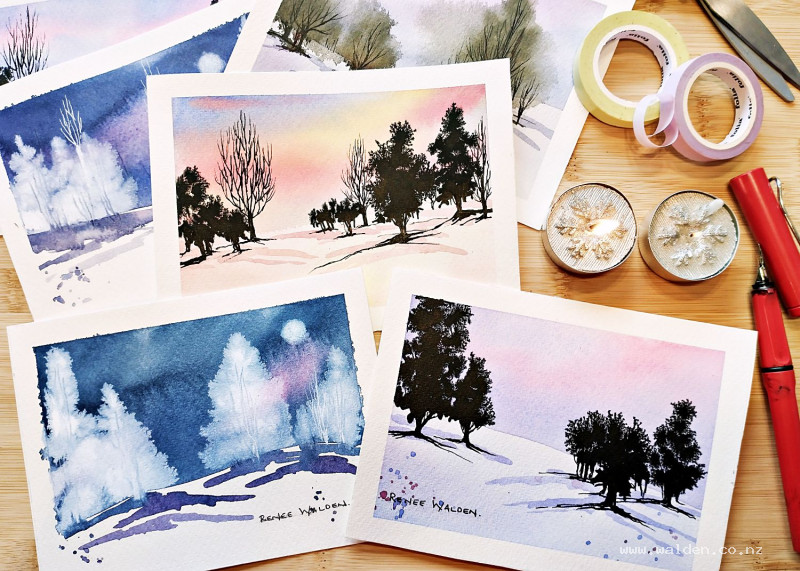
15min Christmas cards
8 February 2023
Video - Level ◆◆◆
Christmas is coming! Did I just say that?! I thought it would be fun to paint some super quick Christmas cards. Each one you do will be a little different and there's lots of fun to be had with experimenting with different colours and inks. This way you can create a whole heap of cards and give everyone you love a little original painting for Christmas.
Video run-through...
About This Painting
Two quick Christmas cards using an ink-drop technique — winter trees feathering out into a snowy sky in the first, and white trees against a deep night sky with a lifted moon in the second. The technique is fast, meditative, and highly variable: every card comes out different. Once you're set up, a whole production run is very achievable.
The magic of both cards is that the tree canopies paint themselves — a drop of ink into wet watercolour spreads and feathers into organic, leaf-like marks without any brushwork. The two cards use different inks for opposite effects: black Indian ink on a pale sky for the day scene, white acrylic ink on a dark sky for the night scene.
Extra materials needed: Indian ink and white acrylic ink (kept in a separate small container to avoid contaminating the bottle), a cheap brush dedicated to the inks (never use a good watercolour brush with permanent inks), two separate water jars (one for watercolour, one for ink), a sgraffito tool or empty ballpoint pen for scratching in trunks, and a small round object wrapped in paper towel for lifting the moon shape.
Card One: Winter Trees (Indian Ink on Pale Sky)
The Snow Foreground
Without any pencil, wet the lower portion of the card and wash in a very dilute mix of cobalt blue and quinacridone rose — just enough colour to suggest cool shadow in the snow. Slightly darker in the corners to give the slope weight. Allow to dry completely before starting the sky.
The Sky
Plan a diagonal slope for the horizon — the slope adds movement and direction to the composition. Wet the sky area and drop in the same cobalt blue and quinacridone rose mix, using more pigment than the foreground so the sky reads clearly darker than the snow below. Add a few streaks of pure quinacridone rose for warmth and colour interest. Work wet enough to keep the sky workable — the trees go in while it's still wet.
Dropping in the Trees
Load a cheap brush with Indian ink (undiluted for denser marks, diluted for more spread) and touch the tip to the wet sky. The ink will feather outward into the damp paper, creating organic, leafy marks without any deliberate brushwork. Drop in a main focal tree first, then smaller ones to the side, varying heights and groupings. Let some go off the edge of the page. Work quickly and don't overthink it — the ink does the work.
While the ink is still wet, use a sgraffito tool or empty ballpoint pen to scratch lines downward through the wet ink, creating pale trunks and exposed roots. This scratches the ink aside rather than removing it, leaving the paper showing through. A little extra ink along the base of the trunks helps anchor the trees to the ground.
Rinse the ink brush immediately into its dedicated water jar.
Finishing Touches
Once dry, add soft shadow marks in the snow around the base of the trees to give the slope form and suggest cast shadows. Drop in a few colour splatters (pink and blue) across the foreground for texture. Finally, use a black fountain pen or fine felt-tip to add a bare dead tree or two in the foreground — a few careful strokes with a sharp nib, working from the trunk outward to the finest tips. This adds a contrasting hard-edged element against the soft ink trees.
Card Two: White Trees on Night Sky (Acrylic Ink)
The Sky
Plan the horizon slope in the opposite direction from the first card for variety. Wet the entire sky area. Mix a very dark colour from the existing purple mix (cobalt blue and quinacridone rose) plus a generous amount of Payne's gray and phthalo blue — this should be a rich, deep night sky tone. Add a streak of quinacridone rose across the sky for an aurora effect; yellow or green also work well. Fill the rest with the dark mix. Work quickly and keep the sky very wet — the trees and the moon both need to go in while it's damp.
Dropping in the Trees
Load the clean cheap brush with white acrylic ink (decanted into a small container to avoid contamination) and touch it into the wet dark sky, the same way as the Indian ink trees. The white ink feathers outward into the dark wash, creating soft white tree canopies. Unlike the first card, the trees can't continue into the snow area below the horizon — stop at or above the slope line, or paint right down and add white trunks with the gel pen later.
While still wet, scratch in pale trunks using the sgraffito tool, pulling the wet white ink downward. Rinse the ink brush immediately.
Lifting the Moon
To make the moon, wrap paper towel around a small round object (a pencil cap, a small coin — roughly 8–10mm diameter). While the sky wash is still wet, press this gently onto the surface to lift a circular area of colour. It won't be perfectly round yet. Once the sky is dry, refine the moon shape by dropping a small amount of clean water into the centre of the lifted area, letting it sit for a moment, then teasing it outward with a clean dry brush to a rounder edge. Repeat a few times until satisfied.
Finishing Touches
Once dry, use a white gel pen to add fine trunk lines below the canopies if needed, and to pick out any additional bare branches or detail. Splatter with pink or blue if desired. The moon can receive a final gentle pass of the white gel pen around its brightest edge if the lifted area needs more definition.
Variations and Extensions
The same technique works in many other directions: a sunset sky with Indian ink trees; an olive or brown ink for softer, mistier trees; acrylic inks in metallic gold or bronze for a more decorative feel; portrait format instead of landscape. Experiment with the inks you already have — unexpected colour combinations often produce the most interesting results.
Consider signing the cards rather than writing a seasonal message — a signed original is more likely to be kept and framed.
Join me on Patreon
Join my Adventures in Colour Tier for $16 to access this post and my full library of over 200 others including deep-dive videos and step-by-steps.