 Video on Patreon
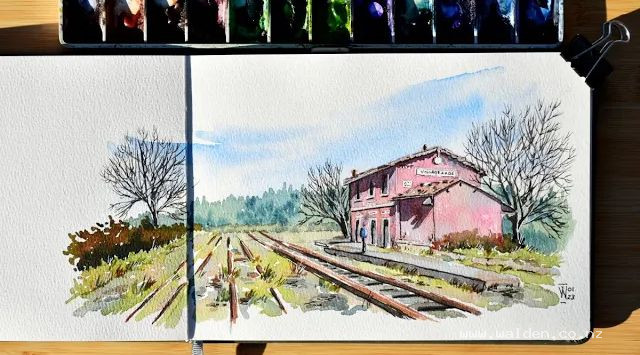
Abandoned railway station, Sardinia
15 March 2023
Video - Level ◆◆◆
High in the hills of Sardinia we came across this abandoned railway station. It's pink! My favourite colour :-)
All sorts of interesting parts to this sketch - one and two point perspective, winter trees, a tiny person and, of course, an old building.
Video run-through...
This hour-long video covers the following material.
About This Painting
An old abandoned railway station discovered high in the hills of Sardinia — rustic, pink-walled, peaceful, with cowbells in the distance and winter trees standing bare against a blue sky. One track is still in use; the others are broken and overgrown. A figure (David, very tall, very long legs) stands on the platform, giving the scene scale and a human story. This was painted inside from reference photos taken on location, and it sits in a sketchbook spread as a memory of a journey through Sardinia.
A traceable drawing is available in the lesson description.
Sketchbook Spread Thinking
When working in a sketchbook on a double spread, the approach here is to draw the main subject first — the station — and then expand the composition outward until it feels right. If it needs to cross the centre fold onto the other page, that's fine. In this case, the station and railway tracks sit on the right-hand page, with a third tree extending the composition across to the left. A smaller complementary sketch (a pig, as it turns out) and written notes fill the remaining space on the left.
Perspective Notes
For anyone drawing the station from scratch: the railway tracks are a classic example of one-point perspective, with the vanishing point to one side of the composition. The station building uses two-point perspective — both sides of the building are visible, each with its own vanishing point (one on the page, one off it). These are worth sketching in lightly before committing to the building shape.
Painting the Sky
Mix cobalt blue with plenty of water and load the brush fully. Rather than a solid flat blue, paint soft, diagonal streaks across the wet sky area to suggest cirrus cloud — the fine, wispy high-altitude cloud that characterises cold winter days. Work the diagonal in the same direction as the overall composition to create a sense of movement. Shape carefully around the building. Let dry completely before proceeding.
The Railway Tracks and Ground
While the sky dries, work on the ground between and around the tracks. Mix three colours: sap green dulled with a touch of orange (for winter grass rather than spring green), a blue-brown gray from cobalt blue and burnt umber (for gravel and stonework), and burnt umber on its own for patches of bare earth and mud.
Use a large brush and work quickly, letting the three colours blend into each other. Follow the perspective of the tracks with your strokes — the sleepers and gaps between them get smaller and closer together as they recede, until they eventually merge. The active track is in better condition and stands out more; the older tracks on the abandoned side are more overgrown and settle into the ground. A few horizontal strokes in the near ground, changing to more angled strokes where the bank slopes.
Work with the big brush throughout — a small brush means fussing, and fussing kills the loose, blended quality needed here.
The Background Hills
Once the sky is completely dry, paint the hills. Mix cobalt blue with sap green, leaning toward the blue side to push the hills back into the distance. The hills are covered in conifers, so use a brush with a good point and paint in short vertical strokes, varying the heights and widths to avoid a mechanical pattern. Keep the colour relatively muted and cool — the pink building will leap forward naturally; the hills just need to stay well back.
The Station Building
The building is pink — a warm, distinctive colour that immediately advances in the composition. Mix your pink (or mix a warm red with white if needed) and paint the main walls, leaving the window and door openings unpainted for now. While still wet, drop in a little variation — a touch of the gray mix in shadowed areas, or a slightly warmer or cooler note in different sections — so the walls don't read as flat.
Paint the gray stonework elements (windowsills, cornices, the platform edge) with the cobalt blue and burnt umber mix. The roof takes a similarly muted gray-brown. Keep the platform surface relatively light; it's where the figure stands and where the eye should feel comfortable resting.
The Figure
Add the figure while the nearby area is still slightly damp so the edges soften naturally — at this scale you don't want a sharp outline. A blue shirt, trousers of a darker tone, and two long legs (longer than you think — people always paint legs too short). A small cast shadow grounds the figure on the platform. Don't add more detail than this; a suggestion is all that's needed.
The Winter Trees
Bare winter trees require fine, confident marks. The approach here uses two tools: a small pointed brush for the main trunk and branch structure, and a rigger brush (script liner) for the very finest branches and twigs. If you don't have a rigger brush, pen work at the end will accomplish the same thing.
Mix a dark brown — cobalt blue and burnt umber, more brown than blue. Load the rigger brush right up into the ferrule. Start from the bottom of the trunk and work upward with a flicking motion, holding the brush upright and loosely. The marks should taper naturally as the branch gets finer. Don't follow the pencil drawing too precisely — let the branches grow until they look right, using the pencil lines as additional marks rather than strict guides. Practice on a scrap of paper first if you haven't used a rigger before; this is the last stage of the painting and not the moment to experiment.
Shadows
Plan the shadow shapes in pencil before painting — particularly the shadows cast by the overhanging roofline, which tell the viewer exactly how far the eaves project. Include shadows inside the window and door openings (even the blocked-up ones — shadows here make the building read as three-dimensional), shadows along the left-hand sides of the building and all its elements, and a cast shadow for the figure.
For the pink walls, mix the same pink with a little Payne's gray and a touch of brown — a purply, slightly warm shadow that complements the pink and separates from it in the wet wash. For the gray elements, the standard cobalt blue and burnt umber gray works well. Work wet so the components of the mix separate on the page and add life to what might otherwise be a flat wash.
Shadows are the step that makes everything make sense. Be brave and put them in.
Pen Work
With everything dry, the fountain pen with dark brown ink handles the final sharpening. Concentrate on shadow sides throughout: the left-hand sides of the tree trunks, the undersides of branches and bushes, the deep shadow inside windows and doorways, the left-hand edge of the railway tracks, and the building's shadow sides. A few grass stalks in the foreground keep the pen marks from feeling too concentrated on the building alone.
Turning the pen upside down gives a finer line useful for the very finest branches and for suggesting writing above the station doors (a nice authentic detail). The white gel pen highlights the sunlit sides of the building and the pale, catching faces of the tree trunks.
Stand back before the final marks — when you find yourself thinking "what should I do next?" the answer is usually to stop.
Add the date and your initials. In the sketchbook spread, the facing page is for notes about the day, the name of the station, and anything else that completes the story — in this case, apparently, a sketch of some rather charming pigs.
Resources...
* Drawing to trace
* Reference photo
Join me on Patreon
Join my Adventures in Colour Tier for $16 to access this post and my full library of over 200 others including deep-dive videos and step-by-steps.