 Video on Patreon
Gingerbread biscuits
7 December 2023
Video - Level ◆◆◆
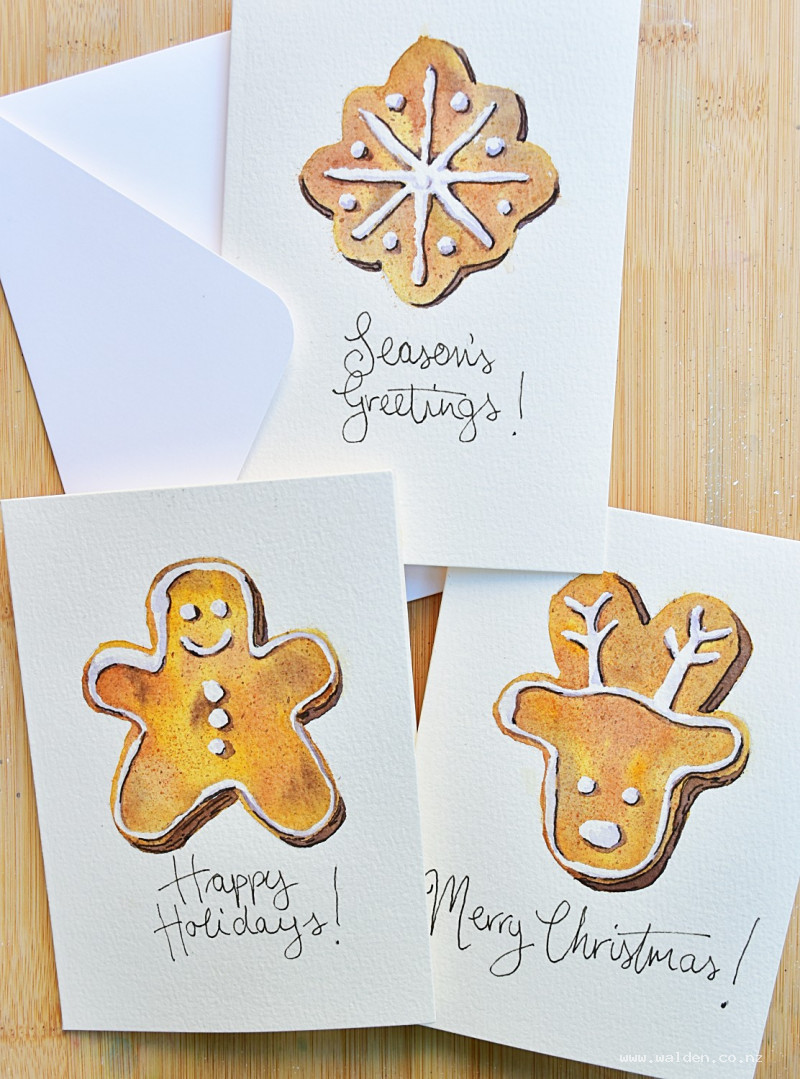
Don't these look yummy? Grab a hot drink of your choice, your paper and paints and let's paint some gingerbread. These are super quick and super fun Christmas cards to make. They're ideal if you'd like to give the extra special folks you know an original card this year.
In this lesson we paint the gingerbread man and the reindeer and I explain how you can adapt the idea to all sorts of cookie shapes. There are 2 reference photos attached with ideas for lots of different shapes.
Happy painting!
Video run-through...
About This Painting
Gingerbread cookies painted on greeting card stock — a gingerbread man and a reindeer, each with piped icing details created using masking fluid. Every cookie can be different, and two reference photos with additional shapes (gingerbread house, candy canes, snowflakes) are provided in the lesson description. These make lovely original Christmas cards, especially if you paint a small production line at once.
You'll need masking fluid and something to apply it with (a ruling pen, toothpick, or an old brush protected with soap), an old toothbrush for splattering texture, and a white gel pen for final highlights. The icing effect is entirely created through masking fluid and shadow work — no white paint is needed for the icing itself.
Making the Cookie Template
Cut a piece of scrap paper to the same size as half your greeting card. Fold it in half, draw half the cookie shape on one side, then hold it up to a window and trace the other side through the paper to get a symmetrical shape. Cut out the template — you now have a reusable cookie cutter equivalent that can be traced around to position the cookie on the card. The organic, slightly imperfect outline of a real baked cookie is part of the appeal, so don't worry about absolute precision.
If painting several cards, prepare all the templates, trace all the outlines, and apply all the masking fluid in one session before painting any of them.
Applying the Masking Fluid
The masking fluid protects the paper where the icing will be. Apply it with a ruling pen, toothpick, or old brush (protect a brush by working soap thoroughly into the bristles first — never use a good brush for masking fluid). Aim for an icing-like quality: slightly irregular, as though squeezed from a piping bag by hand. Vary the thickness and don't make it too neat.
Allow the masking fluid to dry completely before painting — this can take one to two hours depending on temperature. It's ready when it loses its milky appearance and becomes transparent, and no longer feels sticky. Do not use a hairdryer to speed this up, or you risk melting the masking fluid into the paper. If you do use one later in the process, keep it well back and on a gentle setting.
Painting the Cookie
Mix a range of warm browns to suggest the natural variation in a baked biscuit: natural sienna as the base (mix a generous amount), quinacridone gold for golden glowing areas, burnt sienna for deeper warmth, and a little sepia for slightly burnt edges and darker patches.
With a large brush, lay the base natural sienna wash quickly over the whole cookie, working right over the masking fluid and around the edges. Work fast enough to keep the whole surface wet, then drop in the other colours while still wet — quinacridone gold in patches, burnt sienna in others, sepia in the darkest areas. The goal is an organic, uneven surface that looks like real biscuit dough. Allow to dry naturally; don't force-dry with a hairdryer while the masking fluid is still on the paper.
Adding Texture
Once dry, use the cut-out cookie template as a mask to protect the surrounding card. Dip an old toothbrush into fairly thick sepia (not too wet) and flick it across the cookie surface to create fine speckled texture suggesting crystallised sugar. Follow with a pass of quinacridone gold spatter for warmth. Don't overdo it.
Removing the Masking Fluid
Once the cookie is thoroughly dry and cool to the touch, rub off the masking fluid with a normal eraser. If the paper starts to tear, stop and allow more drying time. The white paper beneath will be revealed as the icing shapes.
Shadowing the Cookie
Mix sepia with a small touch of permanent violet — the purple adds life and stops the shadow from looking heavy. With a small brush and light touch, paint the shadow on the right-hand side and underneath the cookie edge to give it a sense of thickness and lift it off the card surface. Keep shadows consistent in direction throughout.
Shadowing the Icing
The icing is rounded in profile, not flat, so its shadow behaves differently from the cookie's edge. Mix a very dilute wash of ultramarine blue and permanent violet — icing is white, so very little colour is needed. Using a fine brush (a size 0 works well here), paint the shadow on the right-hand side and underneath each icing line, varying the width so it echoes the varying width of the icing itself. Paint a short section, then immediately clean the brush, dry it, and soften part of the edge — the shadow should be hard in some places and graduated in others. Work consistently around the whole design.
Once the icing shadows are dry, add a final thin shadow in the cookie colour (sepia and violet) alongside each icing line on the right-hand side. This shows the icing casting a shadow onto the cookie beneath it, making the icing appear to stand proud of the surface.
Pen Work and Final Highlights
Once everything is thoroughly dry, use dark brown ink with a fine nib to sharpen the shadow side edges where needed — underneath the cookie edge, in any icing detail that has become too soft. Keep it gentle; the goal is to sharpen a few specific points, not to outline the whole thing. Nothing on the left-hand side or top edges.
A white gel pen can sharpen and restore the highlight edges of the icing if they've become indistinct — use it on the top and left-facing sides only, and only where genuinely needed.
Resources...
* Reference photo
* Reference photo
Join me on Patreon
Join my Adventures in Colour Tier for $16 to access this post and my full library of over 200 others including deep-dive videos and step-by-steps.