 Video on Patreon
Old door
25 January 2024
Video - Level ◆◆◆
Who doesn't love watercolour paintings of old doors and windows? They have a charm all their own. And, certainly, a whole series of them hanging together would be really lovely.
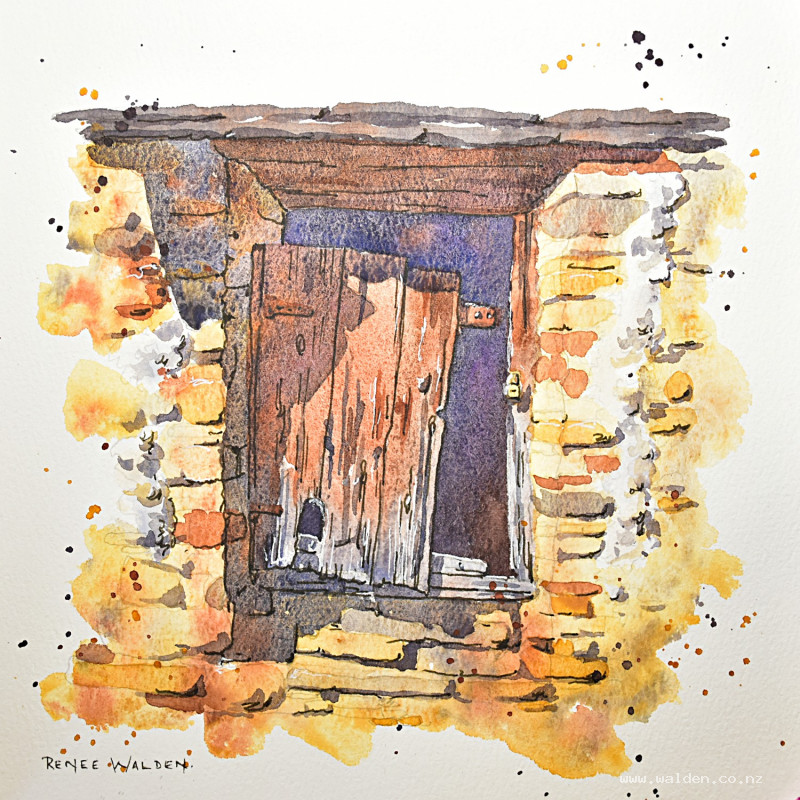
In this lesson we use the skills we learnt in the skills lesson on painting stonework and old wood to paint the old door of the barn behind my house. Plus the shadow is super - I paint it in a similar way to the shadows lesson where we painted the flowerpot.
No need to do the skills lessons first, you can just dive in with this one. But if you'd like to learn more, then the skills lessons are there for you too.
Happy painting!
Video run-through...
About This Painting
An old stone doorway just steps from home — a close-up, intimate subject with beautiful golden stonework, a weathered wooden door, and a dramatic cast shadow from a nearby streetlamp. This is a lesson in getting lost in detail: unlike a landscape where looseness is the goal throughout, a close-up subject like this rewards careful observation of how stones sit together, the angles of old timber, and the way shadows define depth. The pencil drawing, watercolour washes, and ink work are all visible in the finished painting as layers — you can see the thinking process in the marks.
If you'd like a follow-up challenge, there is a related lesson in the challenges section: an old stone door with climbing flowers.
A traceable drawing is available in the lesson description.
The Pencil Drawing
Draw the stonework carefully, showing the individual shapes and how they sit against each other. Get the angle of the door correct. Include the hinges, the padlock, and the small opening at the base of the door. Mark the shadows clearly with hatching — the cast shadow from the lamppost is the most interesting element, and it's worth taking time to observe when the shadows in your reference are at their most dramatic before committing to the drawing.
Hatched pencil marks showing through the final painting are part of the aesthetic here. If you prefer a cleaner look, draw lightly and lift with a kneadable eraser before painting.
Painting Order
All stonework first, then the old plaster patches on the wall, then the door and woodwork, then the shadows across the whole painting, then the dark interior behind the door. Pen and ink finishing comes last.
The Stonework: Base Layer
The stonework is a warm golden colour typical of old stone buildings in this region. Mix a large pool of natural sienna as the base. Have three other colours ready to drop in wet: burnt sienna (reddish brown), burnt umber (dark brown), and a grayish brown made from burnt umber and ultramarine.
With a large, well-loaded brush, paint all the stonework in the natural sienna base colour in one pass — right over the shadow areas too. Work with plenty of water to keep the layer wet long enough to drop in the secondary colours. While still wet, charge in the other colours: burnt sienna for warmer stones, burnt umber for darker ones, the gray mix for the cooler stones. Let them blend softly where they meet. Stand back and check the overall shape, then splatter a few drops of each colour across the stonework using a loaded brush — this creates marks that look more natural than careful dabbing. Allow to dry.
The Plaster Work
Wet the remaining plaster areas on the wall (it doesn't matter if you overlap the stonework slightly). Drop in very dilute gray — burnt umber and ultramarine with a lot of water — and a little sienna in patches to suggest age and staining. The goal is a surface that reads as off-white and weathered, not clean. Keep it loose.
The Door and Woodwork
The door is old timber, darker and warmer than the stonework. Paint the main door colour first — burnt sienna and burnt umber mixed, with variation dropped in wet. Paint the wood grain with vertical strokes on the upright panels and horizontal strokes on any cross pieces. Reserve the brightest areas and don't overblend. While still wet, add darker marks in the recesses and along the shadow edges.
The timber lintel and frame pieces above and around the door are similarly dark. Paint the inside of the doorway and the small cat-hole very dark — this recessed space should read as genuinely deep.
The Shadows
Mix the shadow colour from ultramarine and burnt sienna — a favourite combination because the ultramarine, being a heavy pigment, sinks into the texture of the paper while the lighter brown pigment floats on the surface, producing a beautifully mottled, granulated texture. This is particularly effective on a textured paper. Add a little permanent violet to deepen certain areas.
The main cast shadow from the lamppost sweeps across the door at an angle — paint this as a single connected wash, working quickly across the full area and dropping in colour variations (more blue, more brown, touches of purple) while wet. Hard-edged where the shadow falls on a flat surface; lost and soft where it falls across uneven stonework. Also paint the smaller shadows underneath the rocks, under the hinges, and in the gaps between stones while the main shadow wash is still wet, teasing the shadow colour into them with a smaller brush.
The plaster on the wall casts a slight shadow on the stonework beside it — a thin, soft-edged line of the same shadow mix.
Once the cast shadows are dry, add a final darker pass inside the doorway. Use the same ultramarine and burnt sienna combination but with less water and more pigment. Keep some colour variation even in the darkest area — dropping in a little purple or varying the brown prevents it from looking dead and flat. A too-uniform black interior kills the painting. The small cat-hole at the base of the door should be similarly dark.
Pen and Ink Work
Assess the painting before picking up a pen — if the washes are reading clearly, less ink is always better. The goal is to sharpen a few specific areas, not to outline everything. Keep the mark-making loose; this is an old building and wobbly lines are correct.
Use dark brown ink with a fine nib for the shadow side of everything: the right-hand edges and undersides of the door panels, underneath the hinges, on the shadow side of the stonework around the focal point, a few cracks. Mark in the hinge details and any nails. Do not draw a complete outline around each stone — just the shadow side and the darkest contacts.
Use a white gel pen sparingly for highlights: the padlock, any shiny nail heads, the brightest edges around the focal point. Keep white pen marks minimal — against the warm tones of the stone, white can read as cool and stark if overdone.
Step back and sign.
Resources...
* Reference photo
* Drawing to trace
Join me on Patreon
Join my Adventures in Colour Tier for $16 to access this post and my full library of over 200 others including deep-dive videos and step-by-steps.