Pens, ink, brushes, other bits & pieces
Updated July 2026
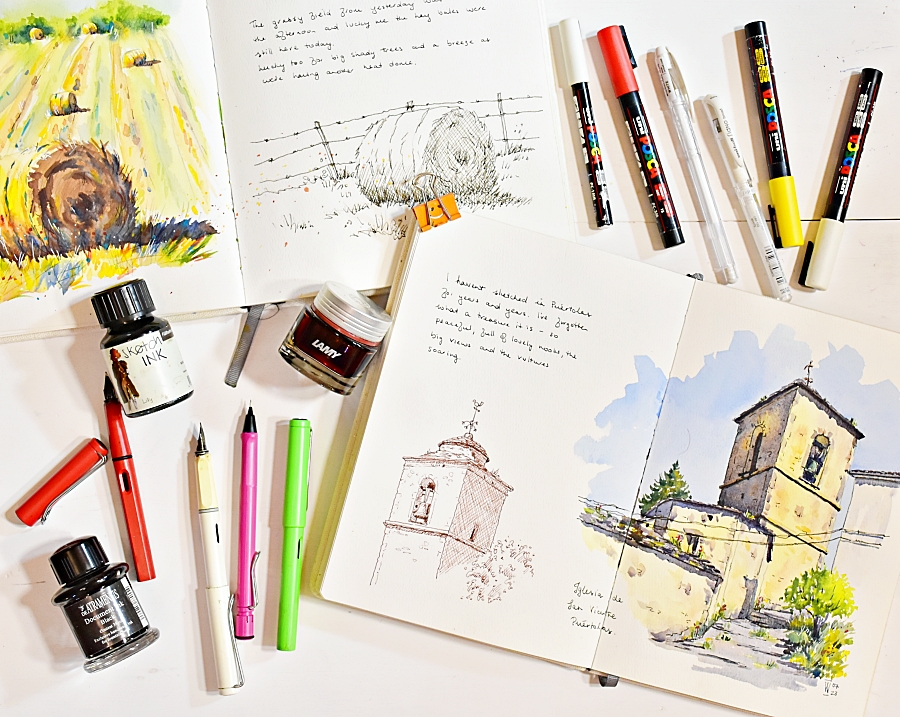
Fountain pens — Lamy Safari, EF nib
For years, like many, I used felt tip markers for sketching. I'm quite heavy-handed with a nib, and I was getting through felt tips quickly — once I did the maths, a fountain pen was actually the cheaper option.
Fountain pens changed my drawing style more than I expected. The angle you hold them at is naturally looser than a felt tip, the ink flows faster, and the line has a life to it.
I use Lamy Safaris because they're robust, affordable, and the nibs are interchangeable. I now have several and a converter in each for easy refilling.
Inks
-
Rohrer & Klingner, Sketch Ink, colour lily
This is a waterproof ink in a very dark olive colour. It reads as dark brown when you draw with it. It's my preference over black ink in most of my sketching because it's more subtle and a better colour match to my palette. Although I usually add ink after my watercolour washes, waterproof ink is still handy because it means I can go back and add more washes after the ink if I need to and not worry about bleeding. -
DeAtramentis, Document Ink, colour black
Black ink works well for me in scenes that are mostly cool tones (blues), where the warmer 'lily' colour above stands out too much. I also sometimes like writing, headings or ink sketches just in black. -
Lamy, colour crystal topaz
A non waterproof ink in a very pretty, warm reddish earth tone. I like it for pen sketches, and for writing in my sketchbooks. Because it's not waterproof it's also fun to sketch first then wet the lines for creating a wash for shadowing.
PS ... The standard advice is to avoid permanent ink in fountain pens, but I've used mine this way for years without issues — the key is flushing thoroughly with clean water every time you refill.
Marker pens
A fine bullet-tip Poscas are brilliant for adding tiny highlights and details at the end of a sketch — especially outdoors, where masking fluid isn't practical. Opaque white is the one I reach for most, but I also use red and yellow occassionally.
White gel pens
Uniball Signo gel pens in fine and broad.
Pencil — Lamy Safari mechanical
Always sharp, never needs a sharpener, spare leads weigh nothing.
Travel Brushes
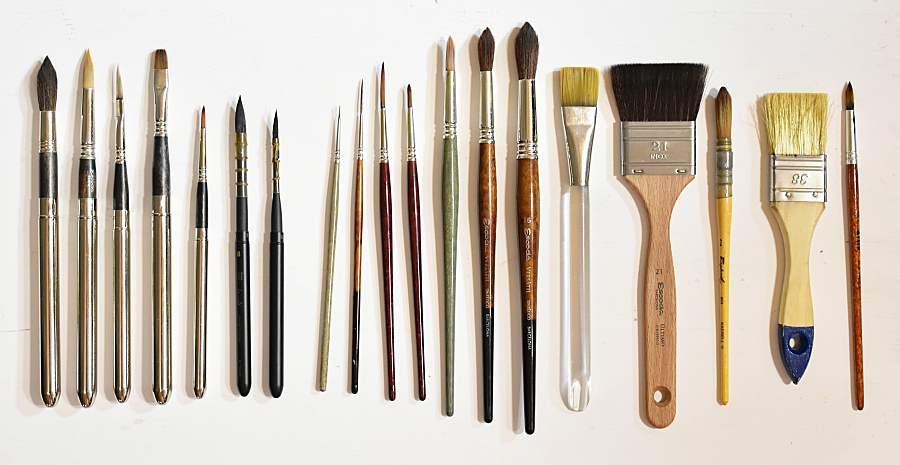
These are the foldable brushes on the left side of the photo (the silver and black handles).
For outside sketching I take either the full set of Escoda brushes (silver handles), just the Perla 12 and 4, or just the 2 Be Wild brushes from Deepdeeplight (black handles).
From left to right
- Escoda Versatil 12 : for big washes
- Escoda Perla 12 : my workhorse, often I only need this one brush for a whole painting
- Escoda Perla 1/4" dagger : for fine lines
- Escoda Prado 10, filbert: for lifting out
- Escoda Prado 4 : for details
- Deepdeeplight Be Wild 8 : another workhorse, from big wash through to tiny details
- Deepdeeplight Be Wild 2 : for details
Studio Brushes
From left to right...
Super tiny brush
Escoda Perla 0
Who am I kidding? I don't usually have the patience for detail that requires a brush of this size.But, sometimes, you know, a teeny-tiny brush is just the ticket. And then you want one that is tough and snappy.
Rigger brushes
Escoda Versatil 0 and 4
For branches, rigging, grasses I use a rigger brush. For studio use only, because they are just too delicate to carry anywhere.
Pointed round brushes
Escoda Prado 2, Escoda Perla 10, Escoda Versatil 12, 16 & 18 (not shown)
My preference is to paint with pointed round brushes. I'm after a brush that holds a lot of water, releases the water consitently and comes to a sharp point. I use a mix of Prado, Perla and Versatil brushes because each has a different flop / snap and I can swap between them depending on what I'm painting.
A brush for splatters
Kaerell Raphael No2
This was a wonderful brush when it was new, but now it's lost it's point a little. It holds an incredible amount of water and is great for fast, loose paintings. Of all my brushes, this makes the best splatter marks.
One inch flat brush
Unfortunately the name has worn off.
Fantastic for painting around things where you want a hard edge. For example, where a building juts into a sky.
Large flat brush
Escoda Ultimo Motler 21
Mostly for pre-wetting the paper for working wet-in-wet and for painting large washes or skies.
Cheap brushes
The stiff wall painting brush for cleaning my palette and water jars. The little brush for masking fluid or ink.
Notes...
- If you're starting out, I wouldn't buy a large number of brushes, because learning a new brush takes quite some time. It becomes an extension of your hand and learning a new snap or "flop" can take a while to accomplish. Each brush also holds a different amount of water, so knowing what's on your brush takes a while to become second nature. So my advice is to do some research, buy the best you can afford, then practise, practise, practise before adding a new tool to the bag.
- What would be my minimalist starting out set? How about these 5 ... Prado 4, Perla 12, Versatil 16, a 1" flat and a cheap small flat for lifting out colour and applying masking fluid.
Other materials
- Masking fluid : Winsor & Newton
- Ruling pen : for applying masking fluid
- Kneadable eraser : Faber Castell
- Masking tape : normal tape from the hardware store
- Dotting tool : for scratching
Happy painting!