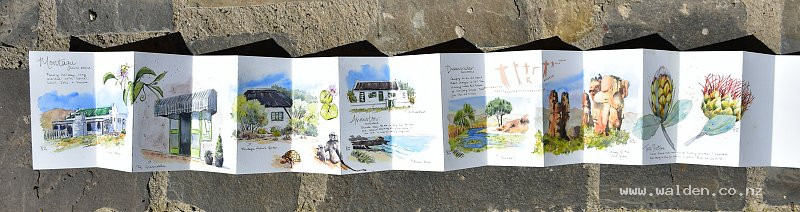
We're just back from a month in South Africa - lots of family time, visits to favourite haunts, climbing and camping, and, of course, a little bit of sketching time.
I grew up in South Africa and whenever I get the chance to sketch there, I come alive in a way that's hard to put into words. Part of it is that the place is part of my soul. The vibrant colours of Africa inspire me, not just in the landscapes, but in all the creative energy of all the cultures. It's here especially that I feel inspired by all the art and designs I see — they're everywhere. The colours feel more saturated, more alive. There's more pattern and texture in the art, in the animals, in the landscapes than anywhere else I've been. I always come home more alive and awake.
This trip was also the first time I worked in a leporello, and it's opened up a new way to think about sketchbooks.
What is a leporello?
The name has a wonderfully dramatic origin. In Mozart's opera Don Giovanni, the disgruntled manservant Leporello compiles a running list — il catalogo — of the thousands of women his master has seduced. In the famous Catalogue Aria, he produces this list as a small folded paper that unravels, accordion-style, into a shockingly long scroll — which is exactly how the format got its name.
You may also know it as an accordion book or concertina book, all referring to the same thing: a single continuous strip of paper folded in alternating directions so that it opens out like a fan. In the Victorian era, leporellos were commonly used as travel souvenirs, depicting panoramic scenes of places travellers had just visited. More recently they've found a real home with plein air painters and urban sketchers, who love them for the way they allow a journey or a place to unfold as one continuous visual story.
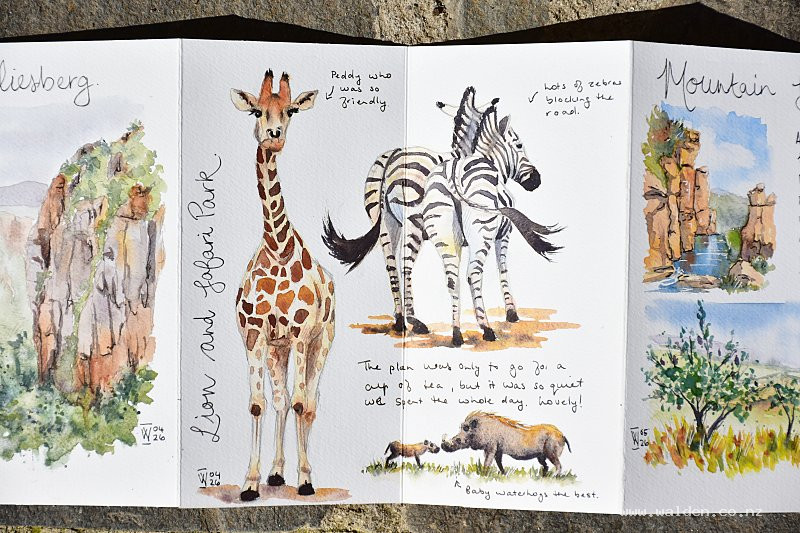
Memories from a day in the Lion & Safari Park near Johannesburg
What I discovered about sketching in a leporello
Playing with composition
When I sketch in a normal sketchbook, I'm very deliberate about compositional flow. Before I start a new spread, I'll page back a few pages so that what I'm about to do makes sense in the context of what came before — if the previous spread is very busy and heavily weighted to one side, maybe the next one needs more simplicity and white space. I'm always thinking about the story across the pages, not just the page I'm on.
What I discovered immediately with the leporello is that you don't have to page back at all. You just fold it out and the whole story is right there in front of you. Which means the composition stops being about the individual spread and becomes something much more visual and immediate — you can actually see how your new section connects to everything that came before, and you can start making decisions about how to join one scene to the next.
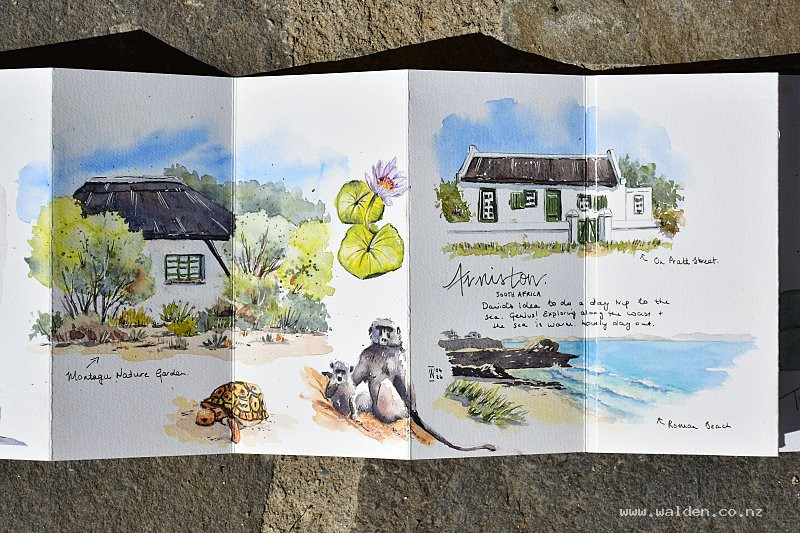
This turned out to be a really joyful puzzle right from my very first sketch. I was drawing the two little cottages at my brother-in-law's place in Montagu, and I used the granadilla plant — the passion fruit vine — to join them together across the fold. As soon as I did that, something clicked. I could see so many possibilities for how to tie one section through to the next. Later, when I moved on from Montagu and wanted to bridge the story to Arniston, I used the tail of a baboon to carry the eye from one spread into the other.
Playing with composition ... joining Montagu with Arniston with a baboon tail
That continuity also brought a consistency to the whole thing that I really hadn't expected. Because you can see the full leporello open in front of you, you naturally start making choices that pull the whole book together — the headings, the placement of writing, the balance of busy and quiet sections — it all becomes much more cohesive than it might otherwise be.
And like anything new, it improved as I went. Looking back at those early spreads, I can see how much my compositional thinking developed over the course of the book. By the time I started my second leporello, I felt a lot more confident.
Two leporellos for one trip
A leporello is quite a bit smaller than a regular sketchbook, which I'd factored in when I packed — I brought two, one for the Cape and one for Gauteng, and that turned out to be exactly right. Each one tells a distinct story of a place, which is something I love. With my regular sketchbooks, I rarely fill an entire book in one location unless I'm somewhere for months at a time. Here, each little leporello is its own complete chapter.
I'm actually still finishing the sketchbooks from photographs — bringing our holiday into my studio at home.
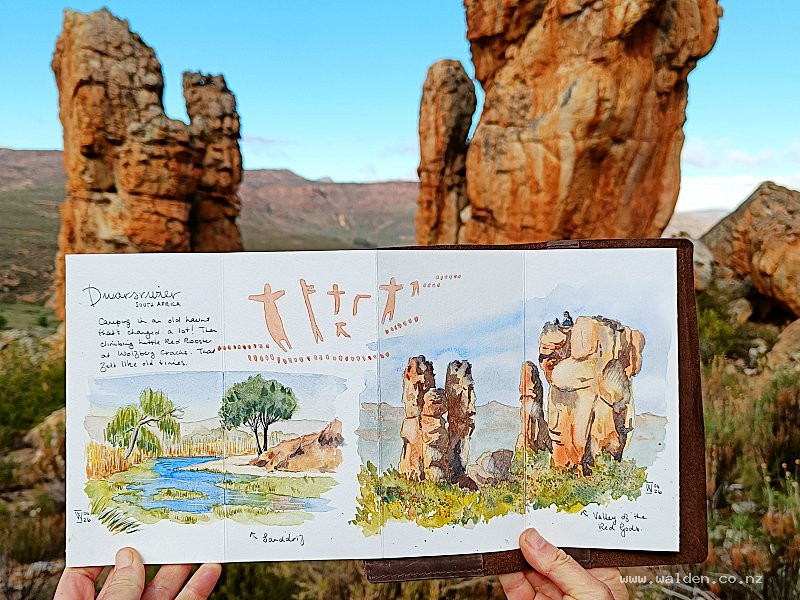
Valley of The Red Gods, Western Cape, South Africa
The leporello itself
I used a leporello from DeepDeepLight — it's quite small (19x9.5cm), which makes it very easy to carry everywhere. It came with a beautifully handmade leather cover embossed with my name, made by Lotte's Papery, which felt very special.
The paper is cold pressed and it's beautifully soft. It makes lovely washes and the colours sit quite well on the surface, which means lifting out and correcting mistakes is very easy. I used the DeepDeepLight watercolours throughout, and I suspect the combination of the two — their paper and their paints — works particularly well together. More on that in the next section.
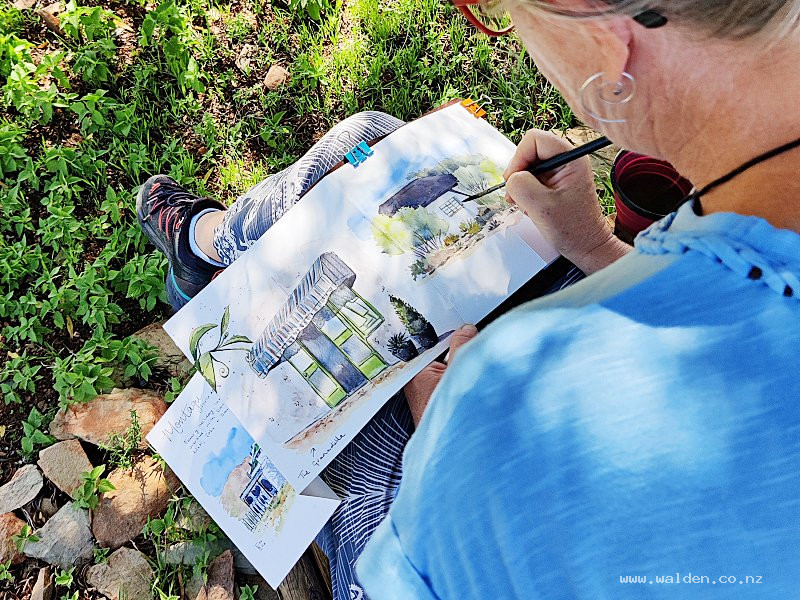
The sketchbook unfolded on my lap - it's a little awkward at first
Practicalities
The awkward bits
The leporello can be a little bit unwieldy, and I want to be honest about that. I was travelling light on this trip — no easel — so I was working almost exclusively on my lap. Having a long folded-out concertina on your lap, ideally with a couple of sections open at once so you can work across the fold, takes a bit of working out. Any slight breeze and things get complicated. I ended up developing a system of clipping it in place inside the cover while I worked, which helped, but it took a few sessions to get it right.
The other practical upside of the paint being so easy to lift off the paper is that splashes and smudges happen more freely when you're not working at an easel — and being able to correct them almost every time was genuinely reassuring. I think I only had one or two staining colours that refused to budge.
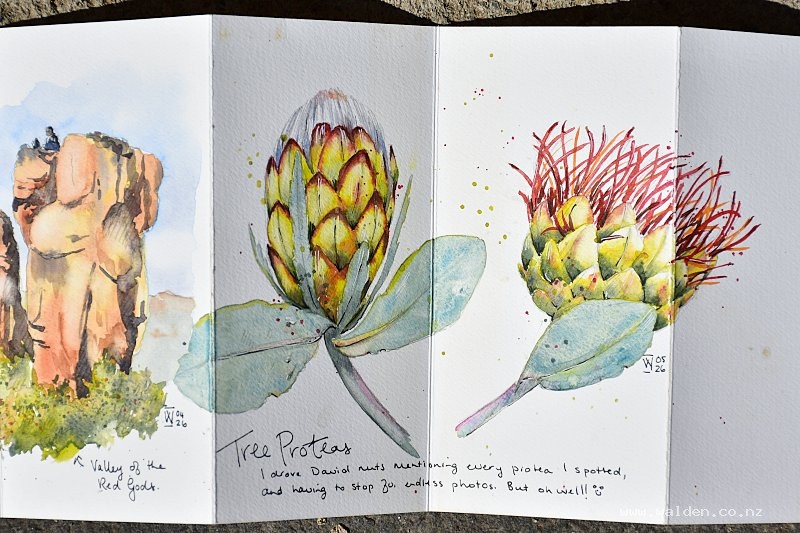
Sketches of proteas. Near the end of the sketchbook and it's a little grubby by now :-)
Learning to let it be a little grubby
This one was harder for me. I am quite particular about my sketchbooks. Anyone who pages through them knows to expect a request to confirm their hands are clean first. But a leporello lives slightly differently from a bound book — the folds pick up a bit of life as you carry it around, and because the pages aren't contained, they inevitably get a little more worn than a sketchbook page would.
At first this bothered me. And then, gradually, it didn't. There's something about a leporello that has been carried and worked in and folded and unfolded that feels lived in. It feels like the book has been on the trip with you, which — when you think about it — is rather the point.
One side or two?
A leporello can, of course, be painted on both sides — which effectively gives you two books from one, a lovely option if you're packing light. I made the decision early on to only work on one side, and I'm glad I did. The reason is that a leporello, unlike a sketchbook, can be completely unfolded and framed. A finished sketchbook is a personal thing — it can't be sold, and that's quite freeing - they're a private book. But a leporello sits in an interesting middle ground: personal enough to be meaningful, but also something that could, one day, live on a wall.
The only thing I haven't worked out yet is storage. Normally a sketchbook sits on a shelf with a spine where you can write the location and the dates. With the DeepDeepLight system, you take the paper out of the cover and reuse the cover for the next book — which I love — but it does mean I need a proper plan for how to store and label the folded books themselves. Work in progress.
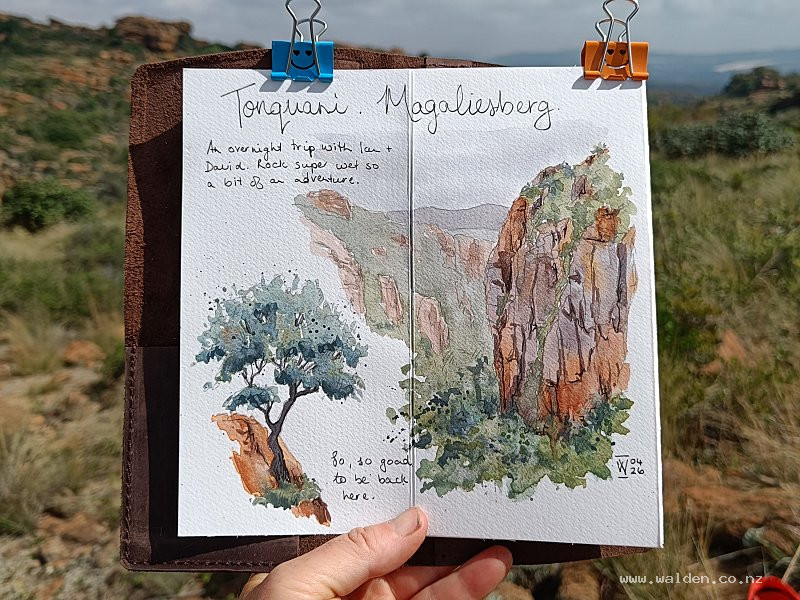
A visit to Tonquani Kloof, Magaliesberg
To conclude
Working in a leporello for the first time was one of those experiences that immediately makes you wonder why you didn't try it sooner. The format suits travel sketching particularly well — the compact size, the storytelling possibilities, the way it unfolds to show you the whole journey at once. South Africa gave me a lot to work with, and I think the leporello held it beautifully.
If you'd like to try one yourself, I have a discount code for DeepDeepLight — RENEELIGHT.
And a reminder that I used the DeepDeepLight watercolours throughout this whole trip. The combination of the two really did work beautifully together.
This is one of the 'what if...' experiments I've been doing lately. As an artist I do them all the time. This one is ... what if I do a coloured pencil drawing and then add watercolour on top? You're ...
Usually I mix my colours.... Most of the time, I mix my own colours. It’s a wonderfully meditative part of the painting process and one I genuinely enjoy. Mixing gives me control, but also a sense o...
I'm off to Italy next week for my last retreat of 2026 and I'm getting all sorts of things ready. One of them is, of course, my palettes. One of the questions I get asked a lot is how I decide which c...