Ater spending time in South Africa recently, surrounded by the kind of wildlife you only see there, I came home with many sketches of zebras, giraffes, warthogs, baboons and more and a strong urge to redo some of these tiny sketches larger.
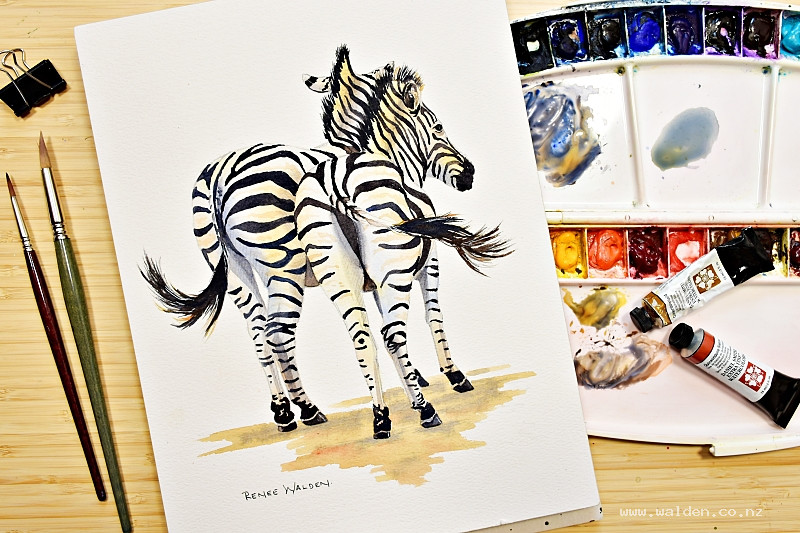
These zebras are the first ones.
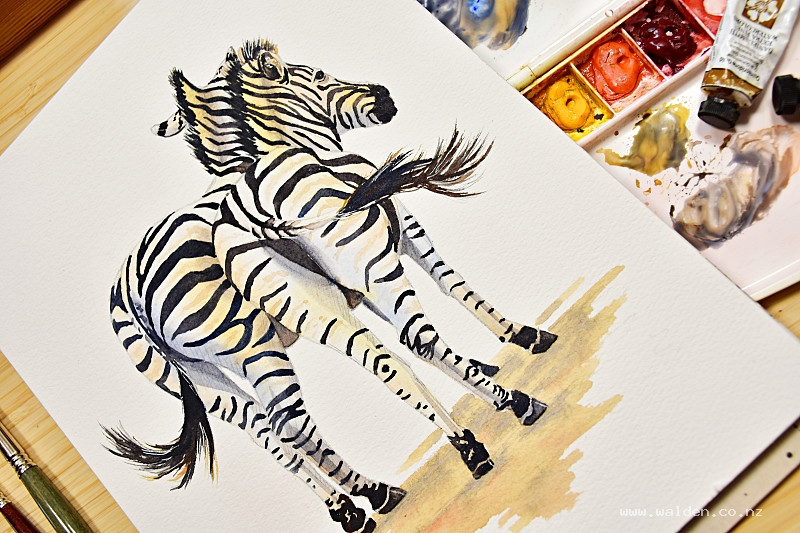
I sketched them during our trip — we got stuck behind a large group of them on the road and I filmed them from behind. Zebra bums are just too gorgeous! This is not the angle you usually see in wildlife painting. No dramatic profile, no eye contact. Just haunches, stripes, and that wonderfully absurd geometry that makes zebras so compelling to paint. I love it for exactly that reason. It's unexpected, a little cheeky, and it makes for a far more interesting composition than the standard broadside view.
What you'll learn in this lesson
This is a genuinely approachable painting, even if you're relatively new to watercolour. The method is simple and satisfying:
A single wet wash to establish the form and the subtle colour shifts across the body — that warm golden light on the haunches, the cooler shadows underneath
Stripes laid on top once dry, working systematically from one side to the other
That's it. The two-stage approach means you're never fighting wet paint with wet paint, and the result looks far more complex than the process actually is.
The one place to take your time is the drawing. Zebra stripes follow the contours of the body, so if the underlying form is right, the stripes will curve and flow naturally. If the drawing is off, no amount of careful brushwork will save it. That said — and I mean this — there is absolutely no shame in tracing. If you want to skip straight to the painting and simply enjoy the wash and the stripe work, trace the drawing, transfer it to your watercolour paper, and get going. The painting is the lesson.
Watercolour tutorial - zebtras
Why these zebras?
South Africa has a way of getting under your skin. I grew up there, and going back always reawakens something — the light, the landscapes, the particular quality of the wildlife. These zebras were part of a series of small sketches I did on holiday, and there's something about painting from direct experience, even translated weeks later into the studio, that gives a painting a different kind of energy. I hope you feel it when you paint yours.
Ready to Paint?
The full step-by-step video tutorial is available now on my Patreon. I walk you through the drawing, the first wash (including how I mix the body colours and keep the wet-in-wet soft and controlled), and the stripe work — including how to vary the pressure and width to make the stripes feel alive rather than mechanical.
If you're not yet a member, you'll find over 150 lessons in the archive, new tutorials added regularly, and a community of watercolour painters at every level. Come paint with me.
This is a detailed post — grab a coffee. I get asked about this a lot, and it deserves a proper answer. I'm often asked some version of the same question: how do I actually progress in watercolour? ...
Last weekend I ran a poll on Patreon and it seems a number of people are interested in different ways to approach watercolours and adding different media. I'm excited about this! Let's mix things up a...
I'm off to Italy next week for my last retreat of 2026 and I'm getting all sorts of things ready. One of them is, of course, my palettes. One of the questions I get asked a lot is how I decide which c...