
Pencil & Drawing
The foundation everything else is built on
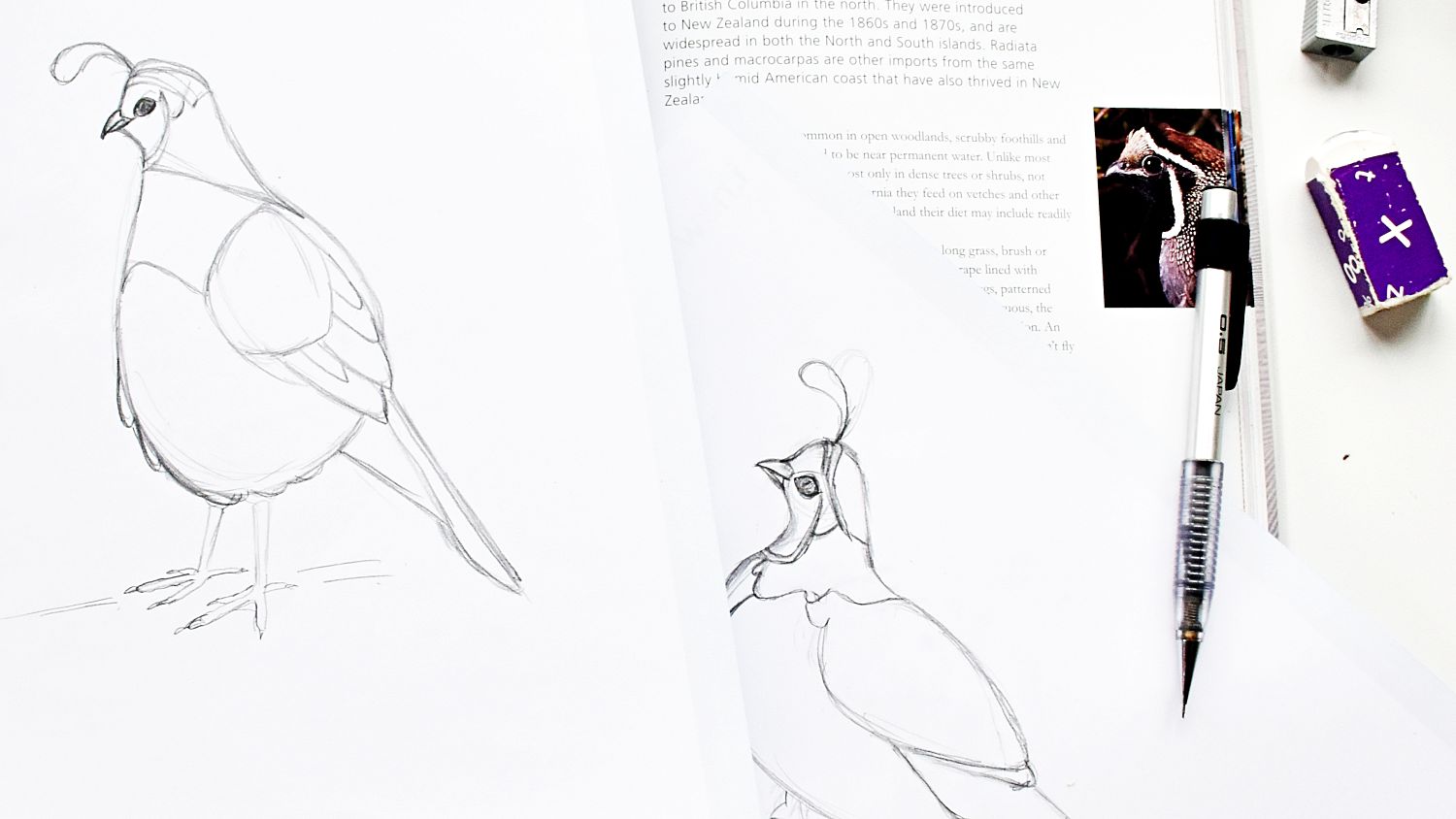
Drawing principles for watercolour
- Decide if you'd like your pencil drawing to show under your washes — this is a personal prefence, and I decide what will suit what subject I'm painting. Some layering of pencil to wash to pen can be effective in some paintings.
- If you don't want your pencil to show then keep your drawing light. Once you wet your pencil marks, it's very difficult to erase them.
- Draw the main subject first, then arrange everything else around it — this ensures the focal point is the right size and in the right place before anything else gets committed
- Mark in shadow shapes at the drawing stage — so they can be painted fast and confidently without stopping to analyse while the brush is moving
- Step back from the drawing — or photograph it — and look at it fresh before picking up a brush. It needs to make sense independently
- A kneadable eraser is handy — it can be shaped to a point and lifts graphite from specific areas without disturbing nearby marks. It can also be rolled over the whole drawing to lighten it or remove smudges.
Composition thumbnails
For any complex scene, spending time on small thumbnail sketches before touching the main paper is worth the investment. Thumbnails let you work out the composition, decide what to leave out, and get the drawing into your head — so you can work with confidence on the final sheet.
What to work through in thumbnails
- Where to place the focal point — not centred? a different distance from each edge? large? small?
- What to simplify or leave out from the reference
- Where the darkest darks and lightest lights fall
- Shadow positions — so they can be painted quickly and confidently later
- Whether the composition naturally leads the eye to the focal point - pathways? lead-in lines? balance points?
Simplifying & selecting
A good drawing for watercolour is a selection, not a transcription. The camera records everything — the painter decides what matters.
- Mark a few key stones, not every stone — the wash will suggest the rest
- Indicate a few main branches — pen work can extend the finest twigs at the end
- Shadow shapes matter far more than individual blades of grass
- Elements that don't serve the story of the painting don't need to be there — lampposts, parked cars, cluttered backgrounds
- Draw things that overlap — overlapping is the simplest way to create depth
Architecture & perspective
Most architectural drawings fail not through lack of skill, but through not checking the linear perspective before starting to paint. It's worth slowing down here and knowing a bit of theory.
Keeping verticals truly vertical
The most common error is letting towers, walls, and door frames lean without noticing. We have a natural tendency to slope our lines. Once pen work goes on top, a lean becomes very obvious. It can help to check long verticals with a ruler against the paper edge before adding any detail.
Checking angles
Hold a ruler against the reference photo along any roofline or ledge and note the angle, then check it against the drawing. This one habit catches most perspective errors before they get painted.
Ellipses
Circular objects — pots, cups, barrels, wheels — appear as ellipses when viewed at an angle. Getting them right is one of the most noticeable improvements in any painter's work, and it's mostly about knowing the rules rather than having special skills.
The rules
- The further an ellipse is below eye level, the rounder it appears; the closer to eye level, the flatter
- For example, the bottom of a pot curves more than the lip — because you're looking down at it from above
- Ellipses must be symmetrical left to right — the left half mirrors the right half exactly
- The ends of an ellipse are always curved — never pointed, no matter how flat it gets
- Check by looking at the drawing upside down — lopsidedness becomes immediately obvious from that angle
Urban sketching on location
Painting buildings on location introduces time pressure that changes how you work — the shadows move, the light changes, and people walk through the scene. A few things that help:
- Deciding what to leave out is just as important as deciding what to include
- Sketch the shadow positions when they're in a good po — they can change fast and are often hard to reconstruct from memory later
- Note or photograph the light direction early; a scene can look completely different an hour later
- For a sketchbook spread, plan the composition across both pages - for example where you'll put your main subject, what other vignettes you'll add, headings and notes.
- Writing notes directly on the painting — the name of the street, the date, something about the place — is something I love to do. It makes a location sketch more than just a picture