
Wet into Wet
The most magical — and most unpredictable — watercolour technique
The five stages of drying
Almost every wet-into-wet decision depends on timing. Watercolour paint passes through roughly five stages:
- Very wet — paint flows freely, colours spread wide
- Wet — paint flows well, colours blend subtly and edges are all soft
- Damp — paint is mobile but slowing; most edges are soft
- Almost dry — I call this the "damp is dangerous" phase. A brush with too much water here will cause cauliflower blooms
- Dry — paint is fixed; marks will have hard edges
Timing: what happens at each stage
Once you become more skillful, you'll notice you're keeping an eye on all parts of your painting and will have a feeling for how wet or damp different areas are. You'll gain more control.
- Into very wet paper: colour spreads widely, soft diffuse edges — use for distant backgrounds, atmospheric skies. The wetter the surface, the further the colour will travel. The key rule: drop colour gently onto the wet surface and let the water carry it — don't push or scrub the paint into the paper.
- Into damp paper: colour spreads less, edges are soft but more controlled — useful for mid-ground elements
- Into nearly-dry paper: colour barely moves, edges are sharp but slightly textured — use for near-foreground details painted wet-into-wet
How to read paper wetness
Look at the surface from a low angle. From that angle you'll be able to see the sheen on your paper and judge how dry it is. You'll also be able to spot any dry spots.
Getting an even wet
- Wet the paper with clean water using a flat brush
- Let the water settle into the paper fibres
- Apply a second layer of water on top
- Check from the side before adding any colour to see if you have any dry spots
Extending working time
For very long wet-into-wet sessions, wet both sides of the paper and work on a non-absorbent surface such as perspex or glass. The water acts as adhesive, adhering the paper to your surface. This method keeps the paper workable for much longer.
Large wet-into-wet areas
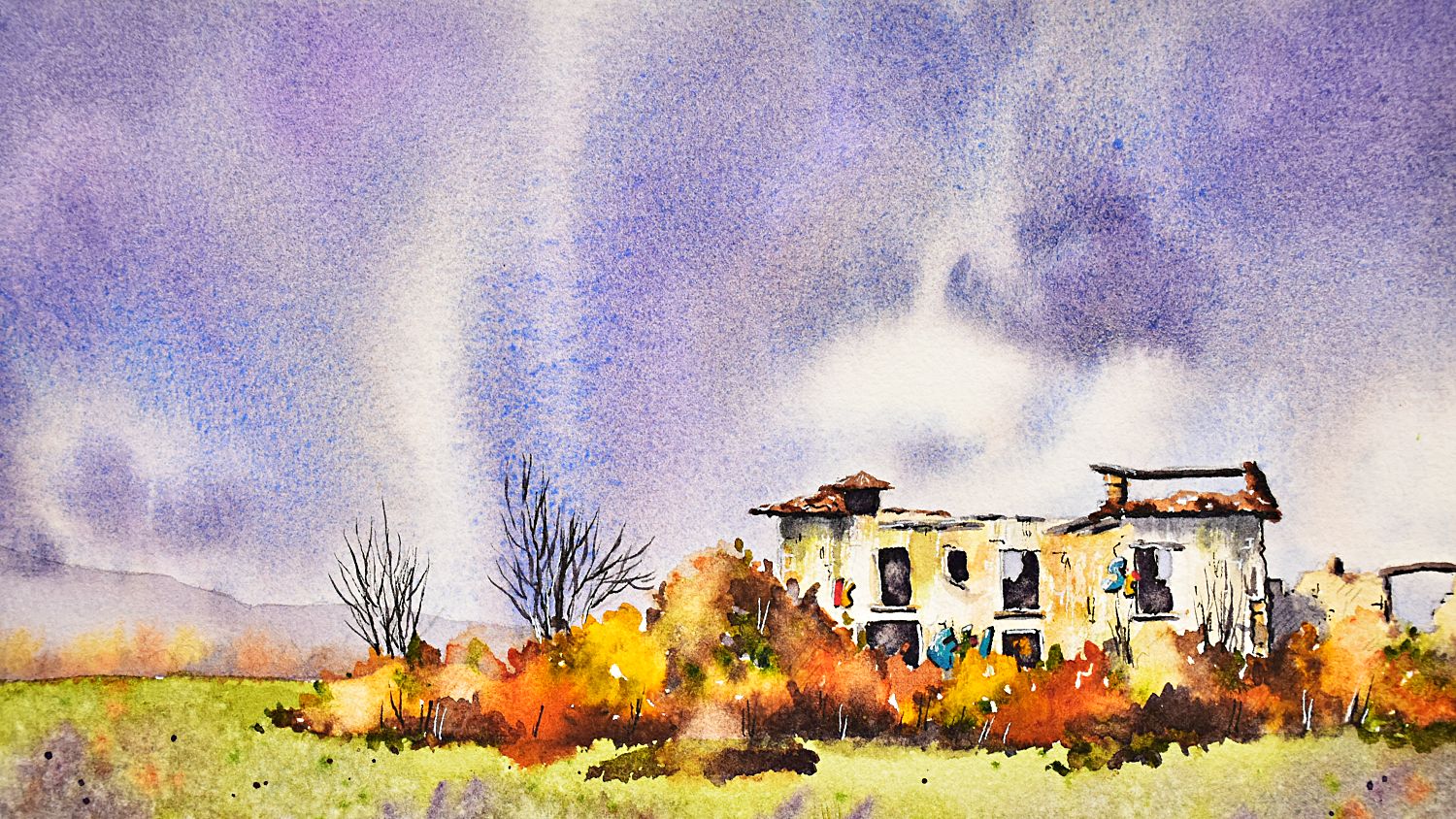
For skies, large backgrounds, and full-page washes, preparation before touching the paper is everything.
Checklist before wetting
- Mix all colours on the palette before wetting — once the paper is wet, you may not have time to mix
- Have all brushes, paper towels, and tools within reach
- Wet the area twice; let the first pass settle into the paper fibres, the second pass adds a layer of water on top
- Check for dry patches or halos around edges — these will cause hard lines
- Work with a large brush so that you can work fast and needn't break your flow too often by reloading
The dry halo problem
A dry edge around masking tape, an object, or the border of a wet area will cause paint to stop abruptly and leave a hard, visible line. Run a just damp brush along any edges where this might occur before adding in your colour.
Dropping colours into wet paint
Rather than mixing colours on the palette and applying one flat hue, drop separate colours into the wet wash on the paper. They will merge, separate, and granulate in ways no palette-mixed colour can replicate.
The technique
- Apply a base wash first — often the lightest colour
- Hold the loaded brush above the wet surface and touch gently — let the paint fall rather than being pushed in. Splattering works well for random marks.
- Drop darker or contrasting colours into selected areas while still wet
- Do not scrub — if colour goes somewhere unwanted, lift immediately with a clean dry brush or paper towel
Colour combinations that separate beautifully
- Ultramarine + quinacridone sienna (granulating shadow mix)
- Cobalt blue + burnt umber (granulating grey for backgrounds)
- Any two colours of different particle sizes — the heavier pigment sinks while the lighter floats