
Trees & Foliage
From distant forest to foreground feature tree
Before you paint: observe the tree
The instinct is to grab the dominant colour and start. Instead: look carefully at the reference first. A maple tree has golds, deep pinkish reds, and near-violet in the deepest shadows. The eye sees more than the brain first reports.
- Study the overall silhouette — where does it break away from the general mass?
- Note which side is heavier, which direction branches lean
- Look for gaps — sky holes in the canopy that stop it reading as a solid blob
- Identify the light source before mixing a single colour
Autumn trees
Work wet-into-wet with bold colour. Looseness is a virtue — every painting comes out differently and that's part of the charm.
Maple (red and violet tones)
Poplar (yellows and oranges)
Technique
- Wet the entire tree and sky area together
- Drop a pale sky wash across the whole area first
- Drop tree colours one at a time while wet — lightest first, darkest last
- Leave gaps — sky holes where birds can fly through
- Once at the right dampness, splatter tree colours for leaf texture
- Once dry, add trunk and branches with a rigger or dagger brush
Winter trees (bare)
Bare winter trees are about structure and atmosphere — the branching pattern, the texture of bark, and how they dissolve into a cold background.
Main trees vs background trees
- Main foreground trees: painted into a still-damp background so edges soften; dark mix of quinacridone sienna + ultramarine; carry trunks down into the ground to anchor them
- Background trees: lighter, warmer colours (natural sienna, pale grey); progressively vaguer as they recede; some can be suggested with the credit card lift technique
Branches
Use a rigger or the tip of a dagger brush. Start from the base working upward — marks get progressively thinner. Hold the brush at the back of the handle for more natural marks. Pen work can extend the finest twigs where even a fine brush is too wide.
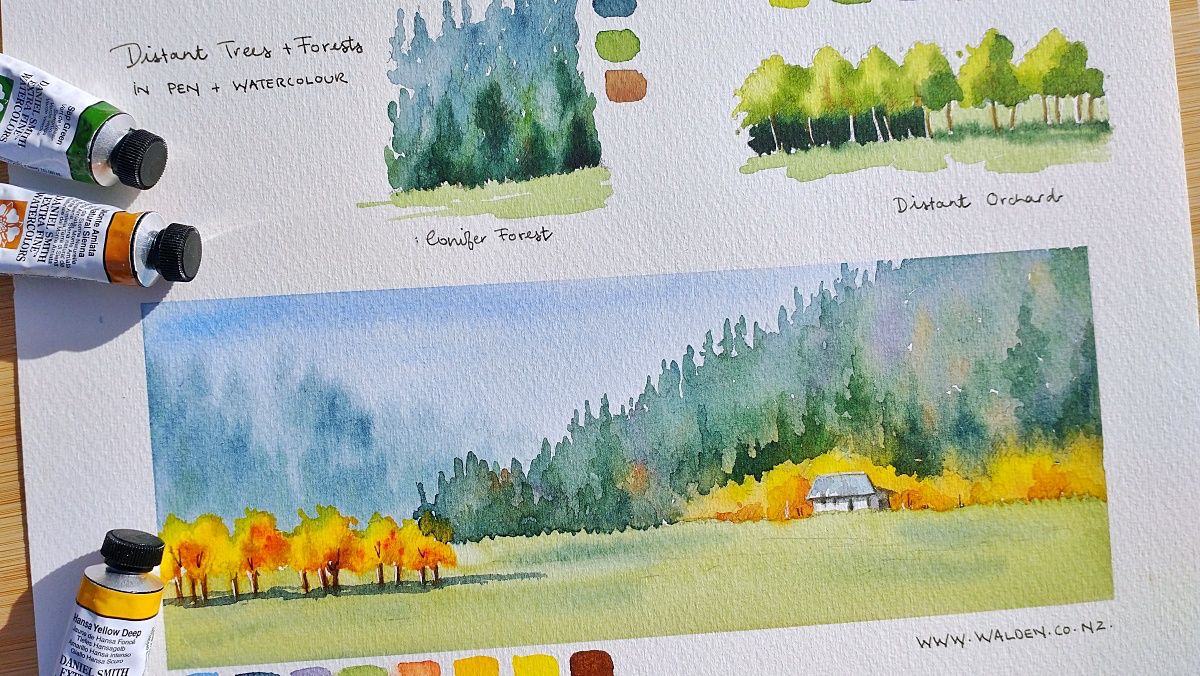
Distant trees and forests
Distant trees follow the same rule as all background elements: lighter, cooler, less saturated, less detailed. This difference is what creates depth.
A conifer slope
- Back trees (touching sky): indigo + plenty of water — blue-grey, very pale
- Move forward: add sap green in increasing amounts, darker and richer
- Foreground trees: very dark indigo + sap green, barely any water — individual shapes emerge
- Keep the skyline irregular — varied heights, no two the same
A single wash, worked wet, can describe an entire forest slope convincingly. Resist the urge to paint individual trees in the background.
Adding a figure for scale
A tiny figure at the base of a large tree immediately conveys scale. Keep it very simple.
Figure formula
- Rectangular body with flat shoulders
- Two legs — one slightly shorter to suggest walking
- Short arms; oblong head
- Keep the head small — gap between shoulder and chin should roughly equal the head width. An oversized head reads as a child
- Use a cool colour (turquoise, blue jeans) against warm autumn tones
- Add a small shadow beneath to place the figure firmly on the ground